
When Three Disruptions Hit at Once
Supply chain risk is usually reported one event at a time: a fire, a flood, an allocation notice, each with its own score and its own news alert. Your plants don't experience them one at a time. They draw on the same buffers, the same distributors and the same expedite budget, so three manageable events can add up to one shortage that none of them would cause alone.
This fall gave us a live example. An AI-driven squeeze on high-end laminates and capacitors, a fire at a Panasonic laminate plant in Taiwan, and flooding at a major Thai industrial estate all landed inside eight weeks. Below is what each one means on its own, how they compound, and what a day-by-day simulation of all three together shows.
Three events, eight weeks
The AI squeeze (ongoing). AI servers are absorbing high-end laminates and high-capacitance capacitors faster than suppliers can add capacity. TrendForce expects the high-end MLCC shortage to run through the first half of 2027. Murata says new capacity is unlikely before 2028, and 1Q27 price talks open this month. Buyers outside AI get what is left after allocation.
Flooding in Thailand (late September). A breached dyke flooded Phases 7 to 10 of Amata City Chonburi Industrial Estate under 30 to 70 cm of water, damaging at least 34 factories (Nation Thailand). More than 10 auto-parts plants stopped, with restarts targeted for October 12. The FTI noted that assembly plants had stock to keep running for now, and that qualifying a new supplier can take almost a year.
The Panasonic fire (November 4). An explosion and fire at Panasonic's Hukou plant in Hsinchu killed two workers and hit a key site for MEGTRON ultra-low-loss laminates. Local reporting cited by TrendForce puts about 4% of global high-end CCL supply at risk, with recovery possibly taking several months or longer because of equipment replacement and customer requalification. The usual fallback, shifting orders to Taiwanese laminate makers, runs straight into the same AI demand.
Each of these has its own owner in most companies: commodity management for the allocation, logistics for the flood, a crisis team for the fire. That is the problem.
How they compound
Concurrent events don't add up. They multiply, because they compete for the same few things that make a single event survivable.
- Headroom. A supplier running at 115% of your need can rebuild your buffer after an outage. Put it on a 10% allocation and that recovery capacity is gone before the next event arrives.
- The same node, hit twice. The fire and the AI squeeze land on the same input. A 30% loss of laminate on top of a 10% allocation leaves 63% of normal supply, not 70%.
- Shared buffers. Plant safety stock and finished goods are sized for one bad month. The first event spends them; the second arrives to an empty shelf.
- Timing. The flood ended on October 12, but a 30-day ocean lane means a Mexican plant feels it in November. Its effects were still in the pipeline when the fire hit.
- Fallbacks that are already taken. Alternate laminate makers, spot buys and expedites are what everyone reaches for at once, and AI customers are first in line.
What a day-by-day simulation shows
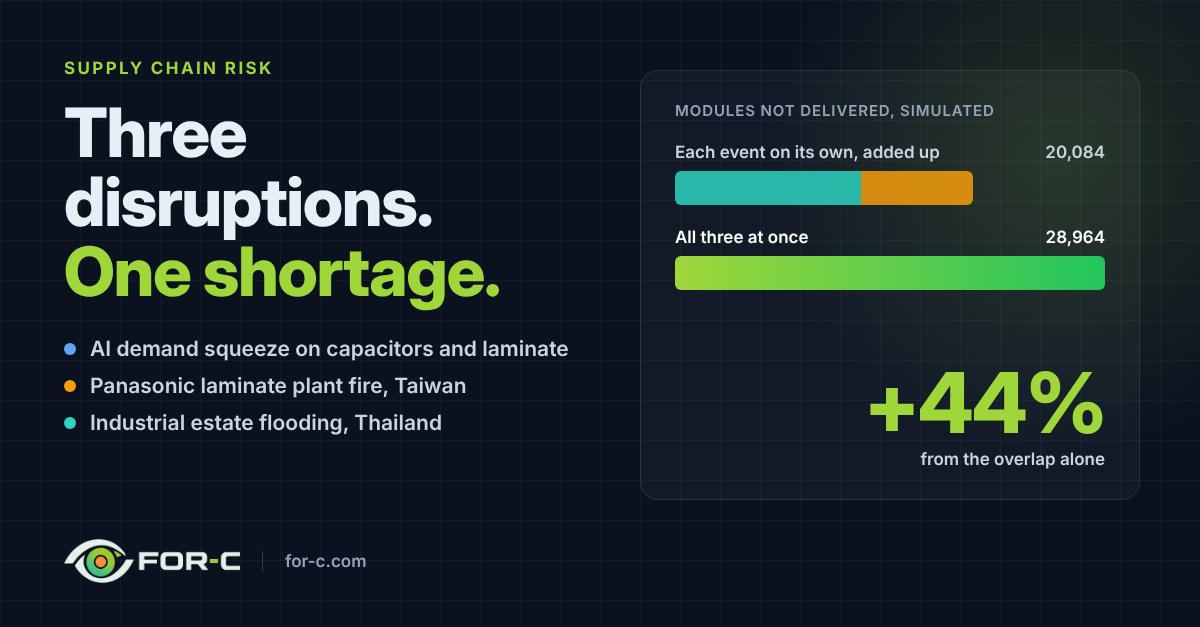
Run one at a time, the three events cost 20,084 control modules over six months. Run together, they cost 28,964, 44% more, or about $5.4 million in delayed revenue instead of $3.7 million.
The network. An illustrative plant in Monterrey ships 1,000 control modules a day to an OEM in Detroit. Each module needs a high-speed PCB from Taiwan built on ultra-low-loss laminate, an MLCC kit from Japan and a connector assembly from Amata City, Thailand. The plant holds about 25 days of each part, ocean lanes run 24 to 30 days, and suppliers can run at 115% of normal need.
The events, sized as assumptions. The AI squeeze cuts MLCC supply 15% and laminate-limited PCB supply 10% from October through March. The flood stops the connector supplier from September 28 to October 12. The fire takes 30% of the PCB fab's laminate for 90 days from November 4, which on top of the allocation leaves 63% of normal supply.
Together, the three events cost more than the sum of each alone
What changes is the timing as well as the total. On its own, the AI squeeze is absorbed, but it uses up the supplier's catch-up capacity. The flood alone shows up in Detroit in early November, five weeks after the water, and then clears. The fire alone starts to bite in late January and holds service near 80% through February. Together, the January shortfall starts on January 4, three weeks earlier, holds service near 72% and runs into March, because there is no headroom left to recover with.
These sizes are not a forecast for any company. Change them and the numbers move, but the pattern holds: the overlap costs more than the three events added up.
Five questions to ask this week
- Which inputs are under more than one stress at once? Put the allocation list, the incident log and the flood and quake map on one page. Overlaps are where to look first.
- What is your supplier's real headroom now? Allocation quietly turns a supplier that could catch up into one that can't.
- What is still in the pipeline? An event that ended last month can still be on the water. Check what is arriving in the next 30 days, not just what is on the shelf.
- When does each site actually go short? The date matters more than the score. It sets how long you have to act.
- What is the last day each fix still works? A spot buy, an air shipment and a second source each have a lead time. Work back from the shortage date and you get an order-by date, and some fixes will already be too late.
The takeaway
Risk lists tell you what is fragile. They don't tell you what happens when three fragile things break in the same quarter, and that is increasingly the normal case. The answer has to be a schedule: which site, which day, how long, and what to do by when.
See these three events run against your own network. FOR-C simulates your sites day by day and shows which site goes short, when, and the last day each fix still works.
Request a Demo